
Princeton Previous-Resident Source Eras
The backward trail for a Princeton address changes with the era. Current parcel records establish the land unit and an assessed owner. Recorded deeds identify title transfers. Older directory volumes can name occupants, and census schedules may show whole households after their public-release delay. Mercer archival series extend the title, estate, and vital-record search far beyond what current portals display.
| Source | Years It Covers | Where Held | What It Shows |
|---|---|---|---|
| Assessment and parcel map | Current cycle; portal cutoff unstated | Mercer Assessor and WV Property Viewer | Parcel, assessed owner, physical address, values |
| Recorded deeds | 1837-1904 microfilm confirmed | Mercer County Clerk; State Archives | Grantor, grantee, instrument, legal description |
| Deed index | 1837-1968 microfilm confirmed | West Virginia State Archives | Index route to recorded instruments |
| Princeton directories | Selected years, 1956-57 to 2016 | State Archives holdings | Dated occupant, address, occupation or business |
| Wills and fiduciary index | Wills 1838-1969; index 1837-1969 | Clerk and State Archives microfilm | Estate relationships and property leads |
| 1915 Sanborn maps | January 1915 | Library of Congress | Block geometry, footprint, and historic use |
Start with the parcel record for a modern property, then move from the latest deed toward earlier sellers. If the question is occupancy in the second half of the twentieth century, search the closest held directory year before and after the target date. For an early tract, begin with its legal description and Archives finding aids rather than forcing a modern street number onto an old index.
Start a Princeton Address Trail
The WV assessment search offers Basic, Appraisal/Sales, Advanced, and Prior Ownership tabs. Record the Full Parcel ID, district, map number, parcel, sub-parcel, owner line, and legal-description or GIS-ID display. Then check the WV Property Viewer for the physical address, E-911 address, parcel boundaries, and any stacked results. These details tie a modern address to land even when the owner’s mailing address is elsewhere.
Mercer’s assessment date is July 1. The Assessor says 2026 tickets use July 1, 2025 information and expects a later update around July 15, 2027. A recent deed may therefore be newer than the tax owner line. Date both sources and let the recorded instrument control the transfer question.
Reach Mercer Deeds Beyond the Web
No official public Mercer grantor-grantee portal was located. The documented fallback is the Mercer County Clerk Record Room, at 1501 W. Main Street, Suite 121, Princeton, with 304-487-8313 listed for the record room. Ask for access by party, book and page, legal description, tract, and date range, and confirm copy rules with staff.
The clerk’s official access page is captured below.
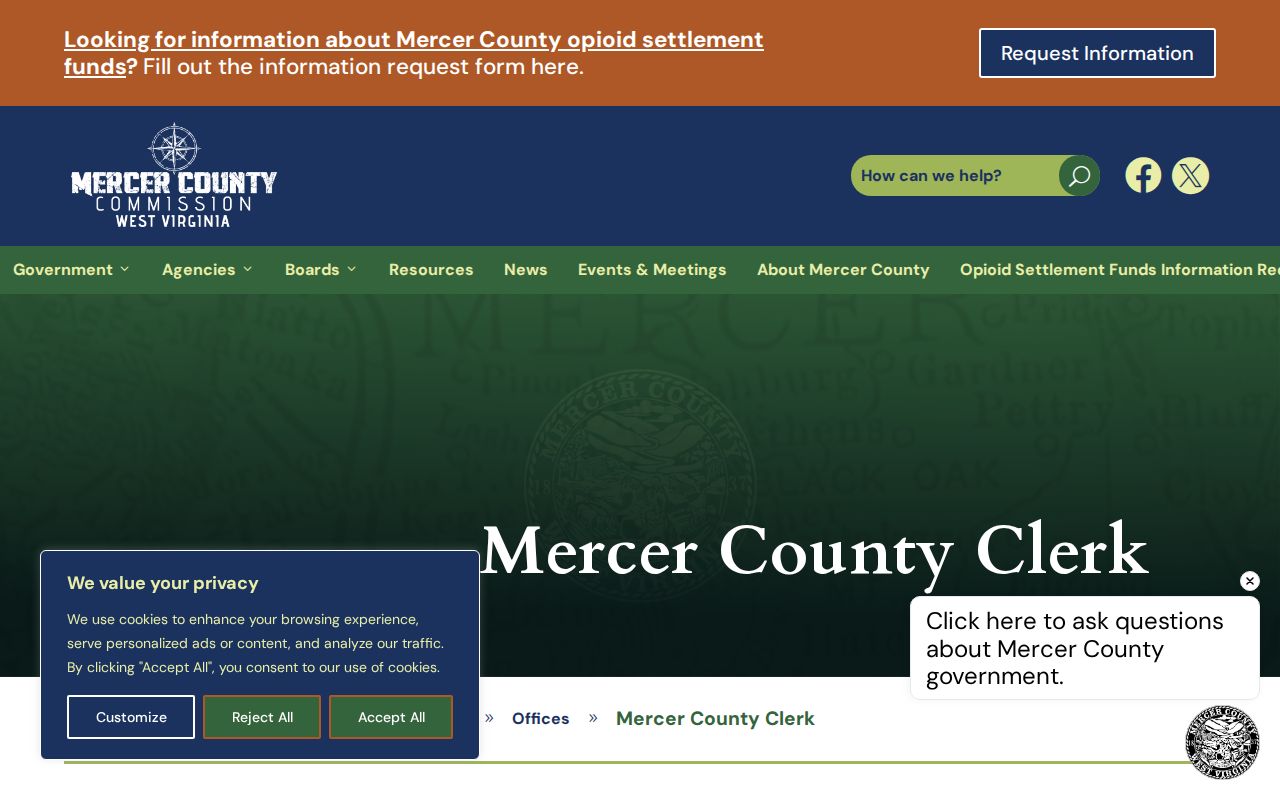
The image represents the official custodian route, not an online deed-result screen.
For older work, the State Archives microfilm list confirms Mercer deeds from 1837 through 1904 and deed indexes through 1968. Coverage dates do not promise that every page is legible or indexed. Ask for the series and roll information before a visit.
Walk Princeton Deeds Backward
A chain of title is the linked sequence of recorded transfers for the same land. Begin with today’s parcel only to obtain the current identifiers. Then use the latest deed to name the seller, locate that seller’s earlier purchase, and repeat. The legal description is often more stable than the street address.
- Copy the current parcel ID, district, map, tract wording, and assessed owner.
- Find that owner’s acquisition deed through the clerk and record its grantor, date, and book and page.
- Search the grantor as an earlier grantee to locate the prior acquisition.
- Compare each legal description, adjoining owner, and parcel reference before linking the transfer.
- Move into Archives microfilm when the clerk’s current system or accessible books no longer cover the needed year.
- Grantor / grantee
- The grantor transfers an interest; the grantee receives it.
- Chain of title
- The linked sequence of instruments that transfer the same property through time.
- Legal description
- Recorded land language identifying a tract, lot, boundary, or survey rather than only its mailing address.
Bridge Princeton Directory Gaps
The State Archives city-directory listing holds Princeton volumes for 1956-57, 1965, 1967, 1969, 1971-77, 1979-80, 1982-98, 2000, 2002, 2006-10, and 2016. The sequence is not continuous. A missing year is a holdings gap, not proof that an address stood empty or a person left Princeton.
Search the nearest volume on both sides of a deed date, census year, or known family event. Capture the volume year, section, page, printed abbreviation, full address, and whether the entry came from a residential or business section. Publisher information was not stated in the official listing and should not be guessed. The collections themselves receive fuller treatment in the Princeton directory book.
The Archives listing can be viewed in the official capture below.
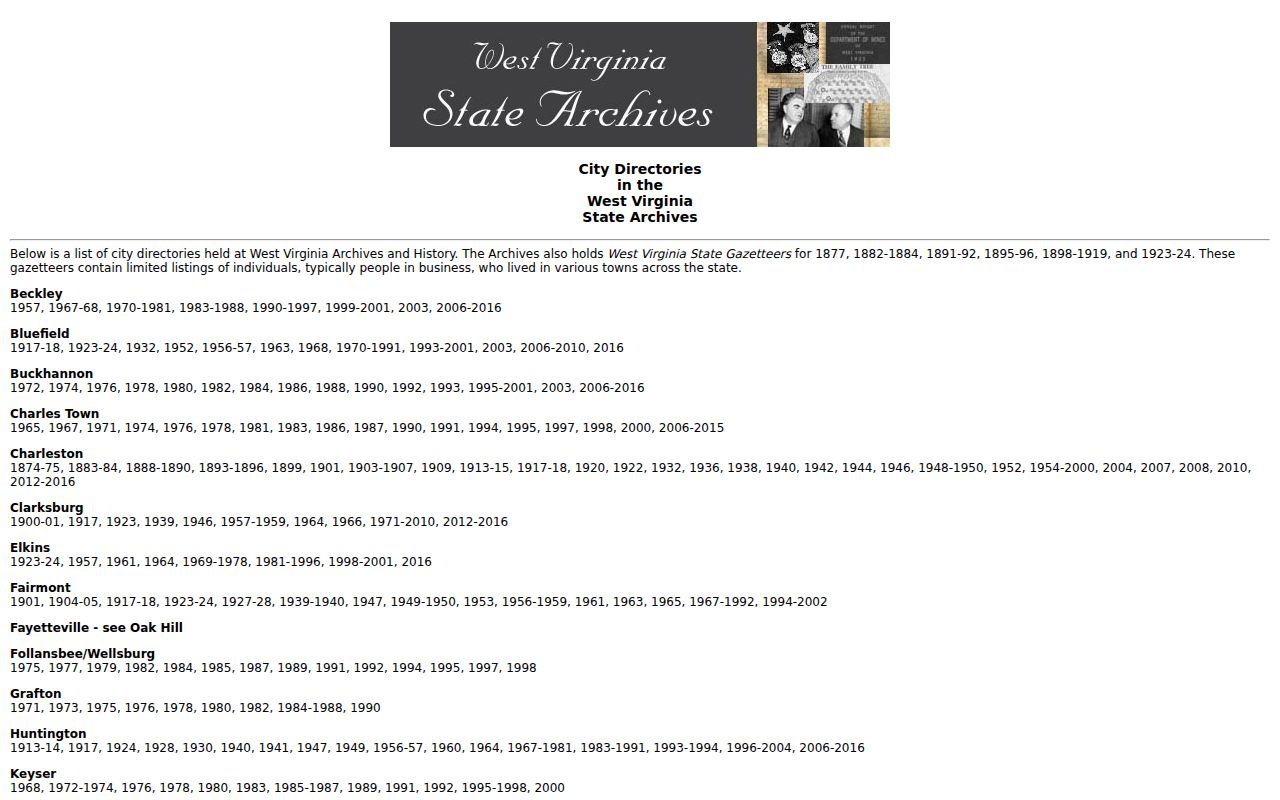
The captured year list shows why past-resident conclusions must be limited to the volumes actually checked.
Match 1915 Princeton Building Geometry
The Library of Congress holds a 14-sheet Princeton Sanborn map set from January 1915. It can show block arrangement, building footprints, and historic uses. Compare that geometry with current parcel boundaries, but do not assume the structure, lot line, or street number stayed unchanged. The research found no official Princeton renumbering table.
Christian Walker’s original 40-lot survey offers another orientation clue. The Railroad Museum history connects Walker Street to the surveyor and identifies Town Spring at Honaker and North Walker. Such landmarks help reconcile an old map and deed. They do not replace a legal description or prove who occupied a building.
Extend Princeton Trails Through Estates
A deed trail may stop when an owner dies, property passes through an estate, or heirs later sign an instrument. Mercer archival holdings include wills from 1838 through 1969, a fiduciary index from 1837 through 1969, and sales and appraisements from 1886 through 1928. Search the decedent in these series, then compare named property, fiduciary, heirs, and dates with the tract evidence.
Probate material can explain why several parties appear on a later deed, but similar names are common. Confirm the court or clerk series and file reference before linking a person to the address. Use only the details needed for family or house history, especially when a file names living relatives.
Note: An estate connection can explain a transfer, but it does not prove that every heir ever lived at the Princeton property.
Add Princeton Railroad Context
Princeton grew with the Virginian Railway, and the local museum history connects early twentieth-century expansion with the depot, shops, trolley, and later changes to rail service. A former resident’s occupation line, a company address, or a building use may make more sense after this context is checked. It remains context, not identity proof.
The Princeton Railroad Museum has books, photographs, and maps, while Craft Memorial Library’s Eastern Regional Coal Archives holds regional company records, ledgers, newspapers, oral histories, maps, and railroad material. Search an accession list and give staff a name, place, organization, and date range. Do not assume every railroad worker listed in a directory worked at the same facility.
Confirm Princeton Previous Residents
Owners are only half of an address history. A city directory may list an occupant who did not hold title, while a census schedule can identify household members at its enumeration date. Search the closest directory before and after a public census year. Record the printed street form and page, then compare names, ages, relationships, and occupations without treating any one field as conclusive.
Use a simple flow: address and parcel, then directory entries, then census household, then obituary or probate evidence. Newspapers and obituaries can explain a move, death, relative, or institution, but they may repeat errors. Mark every prior-occupant statement with the source and date. A person found once at the address should not be described as a long-term resident without more evidence.
Lawful use. Research previous residents for house history, genealogy, estates, and other lawful personal purposes. Never use the results to track, harass, or harm a living person.