
Princeton Directory Years Preserved
The West Virginia State Archives publishes the most specific official inventory found for Princeton city directories. Its list begins with a combined 1956-57 volume, then names 1965, 1967, 1969, 1971 through 1977, 1979 through 1980, 1982 through 1998, 2000, 2002, 2006 through 2010, and 2016. The official entry does not name a publisher, so researchers should record the publisher from the title page of the volume they actually consult. No confirmed online scan collection was located.
| Collection | Years represented | Where identified | Access status |
|---|---|---|---|
| Princeton city directories | 1956-57; 1965; 1967; 1969 | West Virginia State Archives holdings list | Ask Archives about the listed volume |
| Princeton directory run | 1971-77; 1979-80; 1982-98 | West Virginia State Archives holdings list | Holdings listed; scan collection not found |
| Later Princeton volumes | 2000; 2002; 2006-10; 2016 | West Virginia State Archives holdings list | Confirm format and access before a visit |
| West Virginia State Gazetteers | 1877; 1882-84; 1891-92; 1895-1919; 1923-24 | West Virginia State Archives | Limited town and business listings |
A missing date is only a holdings gap. It does not prove that Princeton lacked a directory, that a household moved, or that an address stood empty. Ask whether another repository owns the absent edition, then bridge the date with newspapers, deeds, tax material, probate files, or a federal census.
Verify Princeton Directory Holdings
The State Archives city-directory inventory is the right first stop because it names Princeton and the held years without implying that the books are searchable online. Save the city name, year, title-page details, page number, and section from every consultation. Those notes let Archives staff locate the same item and protect against mixing a residential entry with a business listing.
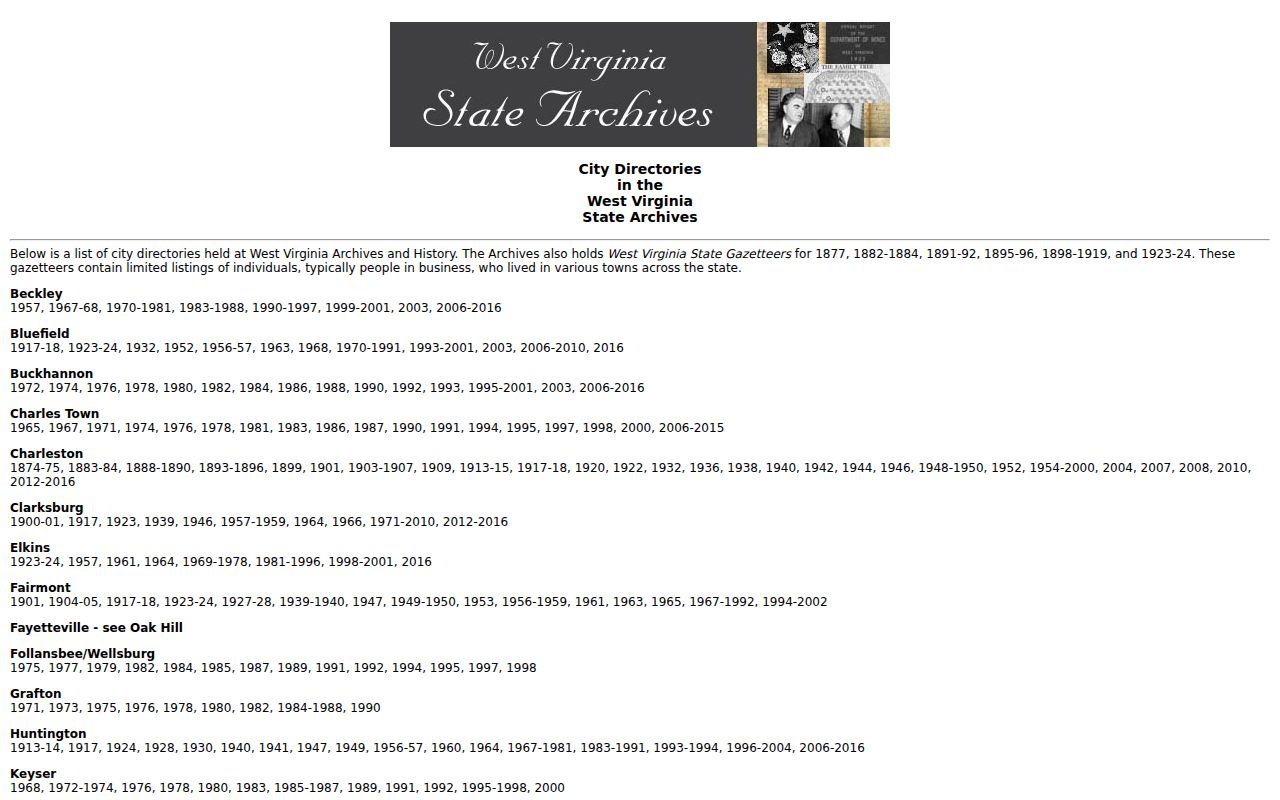
The captured holdings page is an inventory, not a resident search screen. Contact the Archives to ask whether a listed book is available in person, through a reference request, or in another approved form. When requesting help, give one surname or street, a tight year range, and the exact Princeton volume rather than asking staff to create a broad people list.
Decode a Princeton Directory Entry
A city directory entry should be copied as printed before it is interpreted. The Princeton holdings page does not describe the layout of each edition, and formats can shift. Begin with the surname and given name or initial. Then capture the occupation or organization, printed street address, telephone number if present, business cross-reference, page, volume year, and whether the name appears in the residential or business section. Typography and punctuation may separate two people with similar names.
| Name line | Surname, given name, initials, and any spouse or household wording actually printed |
|---|---|
| Work line | Occupation, employer, organization, or business cross-reference, if supplied |
| Place line | Street address and telephone number as printed for that edition |
| Source note | Year, page, section, title, publisher from title page, and repository |
Do not expand an abbreviation from memory. Photograph or transcribe the key from the same volume first. A mark may have a special local or publisher meaning. Likewise, an address line is dated occupancy or business evidence. It is not proof of legal title, and it should not be presented as a current address decades later.
- Criss-cross directory
- A directory arranged by street or telephone number rather than only by surname. The official Princeton inventory does not confirm which volumes include one.
- Householder index
- An address-oriented list that may name the person associated with a dwelling in that edition.
- Abbreviation key
- The volume's own legend for shortened terms and symbols. It controls how that book should be read.
Bridge Princeton Directory Gaps
Princeton's official directory run is discontinuous. That fact changes the research method. If a person appears in 1969 and again in 1971, the unlisted 1970 volume cannot settle whether the person stayed at the same address. Use the last confirmed entry and the next confirmed entry as date brackets, then consult a source created between them.
The State Archives lists State Gazetteers for groups of years from 1877 through 1924, but those works offer limited business and town coverage rather than a full household roll. Its Mercer bibliography also points to Princeton Times and Bluefield Daily Telegraph clippings, county histories, church titles, and local works. Useful call numbers include 975.474 M554, 975.474 M554m, and 975.474 S215. Keep the call number in a request because a title alone may not identify the correct item.
For older dates, Mercer microfilm adds deeds from 1837 to 1904, a deed index from 1837 to 1968, wills from 1838 to 1969, and a fiduciary index from 1837 to 1969. A directory gap may be narrowed with those sources, yet each still needs its own date and purpose in the final notes.
Ask Princeton Library Precisely
Princeton Public Library is a useful local contact at 920 Mercer Street, Princeton, West Virginia, and 304-487-5045. Its public material identifies newspapers, magazines, computers, and electronic resources. It does not publish a dedicated genealogy database page, obituary index, reverse-directory search, or detailed city directory shelf list in the sources reviewed. That gap should shape the question instead of becoming an unsupported claim about what the library owns.
The Princeton Public Library website is the source for current contact details and service information. Ask staff whether they hold a particular year, newspaper date, clipping file, or finding aid, and verify access before traveling.

The library was established in 1914 by the Princeton Women's Club, according to the West Virginia Library Commission. It moved in 2010 to the Old Princeton Post Office, built in 1935. That institutional history makes the library a logical contact, but staff confirmation remains essential for any exact collection.
Place Princeton Railroad Households
Railroad history supplies context that a city directory abbreviation may leave out. The Princeton Railroad Museum says Virginian Railway work developed from surveys begun in 1905, followed by the depot, shops, a 45-stall roundhouse, and the line reaching Deepwater in 1909. The same narrative reports a trolley in December 1909. An occupation or company name in an entry can therefore point toward maps, photographs, newspapers, ledgers, or museum material tied to that industry.
The museum reports Princeton populations of about 881 in 1900, 3,027 in 1910, and 6,224 in 1920. Those are museum-page figures and must be labeled as such, not treated as a substitute for a census table. They help explain why a later Princeton city directory could show a much denser set of people, firms, and institutions than an earlier town source.
Craft Memorial Library's Eastern Regional Coal Archives in Bluefield holds company records, maps, newspapers, oral histories, photographs, rare books, scrapbooks, and railroad material. Those collections can explain a workplace or neighborhood link found in a historical entry without turning that clue into a claim about present identity.
Map Old Princeton Directory Addresses
The Library of Congress holds a 14-sheet Sanborn fire-insurance map set for Princeton dated January 1915. A Sanborn sheet can show a block, structure footprint, or past building use. It does not name the legal owner and does not prove that a later structure is unchanged. Compare its sheet and block geometry with the street name printed in the directory, then use current GIS only as a modern reference point.
Address matching needs special care because no official Princeton street-renaming or renumbering table was located. Legal descriptions, adjoining owners, district, map, and parcel identifiers may survive changes that break a simple street-name search. Walker Street also carries a local clue: the museum history says Christian Walker laid out the original 40 lots after Mercer County formed in 1837. That story can guide a map search, but the precise conversion from old lots to modern parcels still requires records.
Trace Families Through Princeton Directories
Build a dated chain rather than treating one listing as the whole answer. The strongest trail keeps the exact source for every point and marks assumptions plainly. A disappearance may mean a move, death, omission, spelling change, or an unheld edition. It is not an answer by itself.
- Start with the nearest held Princeton volume. Copy the full name, street, page, section, year, and wording.
- Check the prior and next listed years. Note changes in initials, address, organization, and household wording.
- Pair directory dates with available census, newspaper, vital, probate, or deed evidence. Keep occupancy and title in separate columns.
- Use a Sanborn sheet for historic block context and current GIS for present parcel orientation. Do not assume the street number stayed the same.
- Ask the Mercer County Clerk or State Archives for the specific index, roll, book, or record needed to test the remaining gap.
For a modern name that grows from a historical find, use the dedicated Princeton resident lookup workflow. Keep old city directories cited as historical evidence. A careful family history states what the record showed, when it showed it, where the item is held, and what remains unknown.